
Medical
Understanding biofluids to accelerate medical innovation
When the properties of a biofluid change, they often indicate the onset of a disease or the effect of a treatment. We transform these variations into scientific data that healthcare professionals can ultimately use.
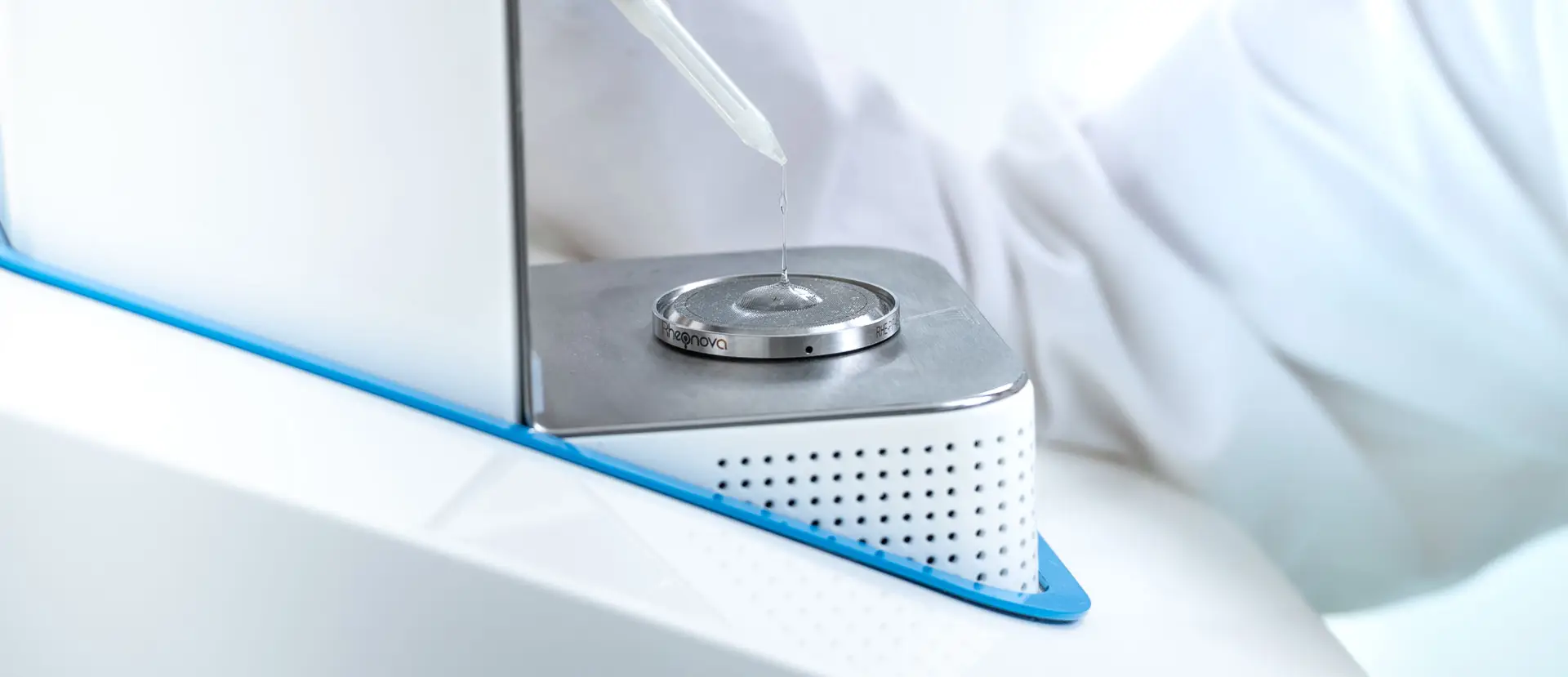

Why include rheology in your research projects?
Rheology for discovery
The mechanical properties of biofluids provide essential information about physiological status, the progression of a disease, or the effectiveness of a treatment. Rheology helps reveal these signals, which are often invisible to conventional analyses.
Identify functional biomarkers
Compare the properties of a biofluid in a healthy state versus a pathological state.
Evaluate the Effectiveness of a Treatment
Measure objectively the changes brought about by a therapy or formulation.
Monitor progress over time
Implement longitudinal monitoring protocols for preclinical and clinical studies.
Characterize Your Innovations
Analyze injectable formulations, hydrogels, biomaterials and biological substitutes under conditions that closely mimic physiology.

Applications
Expertise tailored to each biofluid
From respiratory mucus to synovial fluid, the rheological properties of biofluids reflect their physiological function and pathological state. Characterizing these properties provides valuable insights for understanding disease mechanisms, evaluating treatments, and developing new therapeutic approaches.
Mucus and bronchial secretions
Altered viscoelastic properties that compromise mucociliary clearance.
When mucus becomes too viscous or sticky, its clearance is impaired. Rheology makes it possible to measure these alterations and use them as objective biomarkers.
Blood and hemorheology
Blood viscosity, a biomarker that remains underutilized.
Blood is a complex fluid whose rheological properties change in response to disease, inflammation, or the effects of treatment. Hemorheology makes it possible to measure these changes and identify biomarkers that conventional laboratory tests cannot detect.
Synovial fluid
When the joint loses its natural lubrication.
The properties of synovial fluid change with osteoarthritis and inflammatory diseases. Characterizing these properties provides valuable information about disease progression and the effectiveness of intra-articular treatments.
Vitreous humor and ocular fluids
When the vitreous gel loses its mechanical properties.
The progressive liquefaction of the vitreous humor is implicated in several retinal diseases. Its rheological characterization provides valuable data for research and the development of innovative therapeutic solutions.
And many other biofluids
Saliva, cerebrospinal fluid, seminal fluid, bile… The rheological properties of these fluids represent a source of information that remains largely unexploited in biomedical research and therapeutic innovation.

Shaping
rheology solutions
Define a protocol tailored to my biofluid


Measurements Tailored to Complex Biofluids
The data that your research needs
We characterize the flow, viscoelastic, and structural properties of biofluids to provide reliable and actionable data for your research and development projects. All of our analyses can be performed under controlled physiological conditions: 37 °C, controlled pH, and small sample volumes.
Viscosity and Flow
Viscosity measurement and characterization of Newtonian, non-Newtonian, and shear thinning behaviors.
Viscoelasticity
G' and G'' modules, complex viscosity, phase angle (tan δ), frequency and amplitude sweeps.
Adhesion and Structure
Adhesion and cohesion properties, and the kinetics of gelation and liquefaction of biofluids and hydrogels.
Microrheology
Analyses using just a few microliters of sample, suitable for scarce or valuable biofluids.
FAQ about medical rheology
Why measuring the viscosity of a biofluid rather than its biochemical composition?
Composition and rheology are two complementary aspects. A biofluid can have a normal composition but altered rheological properties, because it is the three-dimensional organization of its components, not merely their presence that determines its mechanical behavior and the associated disorders. Rheology captures what biochemistry alone cannot.
The volumes available for analysis are often very small. Is this an obstacle?
No. We have protocols adapted for small volumes, particularly for rare or precious biofluids (mucus, synovial fluid, vitreous humor, CSF). With easyRheo, we can test 20 µl of fluid.
Can your data be used in a regulatory submission or a scientific article?
Yes. Our reports specify the complete operating conditions, the equipment used, the protocols applied, and the relevant regulatory references. They can be used directly for a publication, a marketing authorization application, or a clinical trial report.
Do you work with academic and hospital teams?
Yes. We collaborate with research laboratories, university hospitals, and clinical teams as an analytical service provider, research partner, or expert within the framework of an institutional protocol.
Can regular rheological monitoring be implemented as part of a clinical trial?
Yes. We offer longitudinal monitoring protocols with analyses at various sampling time points, which are particularly well-suited for evaluating the effectiveness of a treatment on the rheological properties of a biofluid.