
Research
Instruments,
from research to transmission
From researchers exploring new phenomena to students discovering rheology, our range of instruments is designed to meet all academic needs while balancing performance and simplicity.
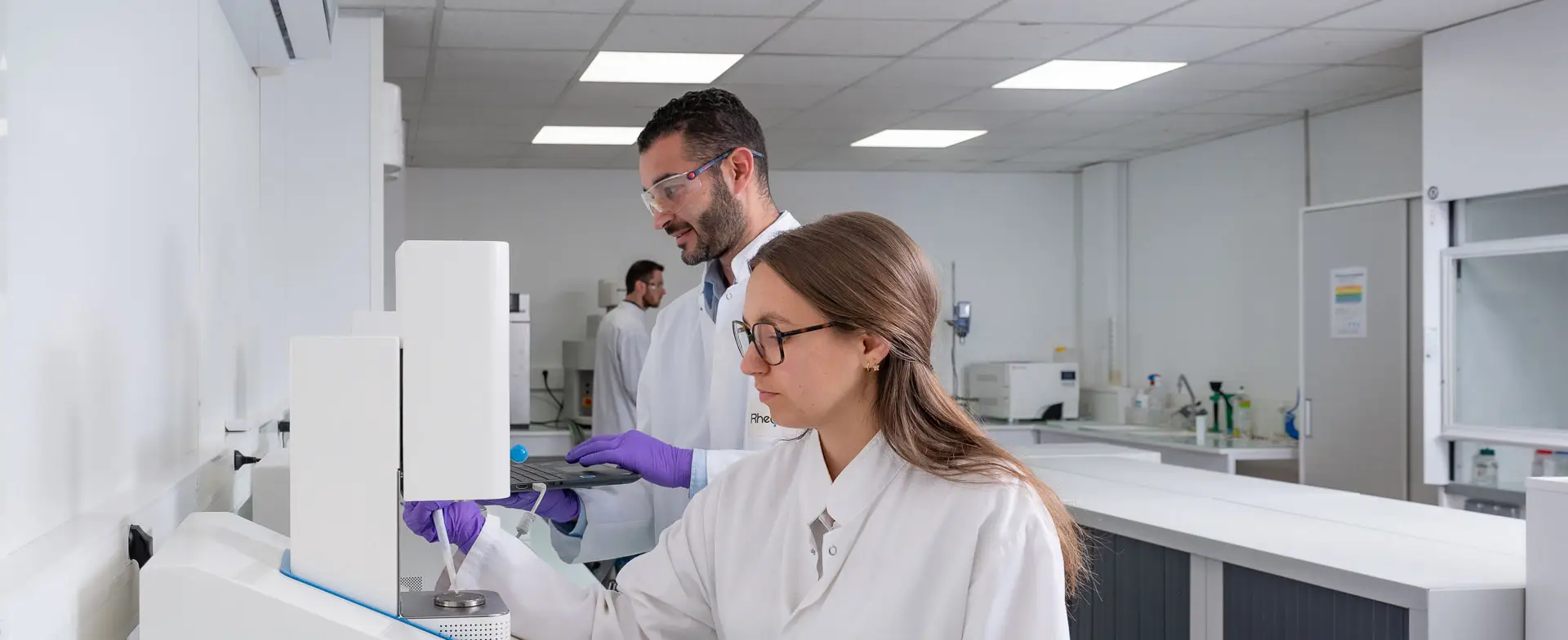

Researchers and PhD students
Access the full complexity of fluid behavior
Our complementary instruments allow you to characterize your systems in all their dimensions
and explore phenomena that are inaccessible with a single rheometer.
easyRheo : rotational rheometer
A rheometer that appears simple at first glance, but is designed to go above and beyond: full access to data, experimental flexibility, and measurement accuracy. A compact, easy-to-use rheometer designed for research: full access to raw data, total experimental flexibility, and measurement accuracy. Ideal for characterizing the linear and nonlinear viscoelasticity, G’ and G’’ moduli, tan delta, yield stress, and thixotropic behavior of your systems.
FV-30 : extensional rheometer
An instrument designed for extensional rheology that revolutionizes CaBER-type testing by offering greater control and reproducibility. An instrument dedicated to extensional rheology that redefines the CaBER (Capillary Breakup Extensional Rheometer)-type testing experience with greater control, reproducibility, and functionality. Measures extensional viscosity, elongational viscosity, and the elongational properties of materials. Features an integrated camera and live visualization software.
TriPav : high-frequency rheometer
Analyze the behavior of fluids under rapid dynamic conditions, ideal for inks, paints, and complex systems. Analyze the viscoelastic behavior of your fluids under rapid dynamic conditions that are inaccessible to conventional rotational rheometers. Ideal for inkjet inks, paints, drilling fluids, and all systems where high-frequency behavior is critical. A natural complement to easyRheo to cover the entire frequency spectrum.

Shaping
rheology solutions
Explore new dimensions in rheology

Teachers
Making rheology tangible and accessible
Teaching rheology means bridging the gap between theory and practice.
Our instruments are designed to simplify experimental procedures and maximize learning.
Quick setup
Installation requires no heavy infrastructure, no compressed air, and no temperature-controlled bath.
Intuitive usability
Ready-to-use protocols for effective practical sessions starting with the first session.
Easier to understand
Automated analysis and modeling to directly link experimental results and theoretical concepts.
Expert insight
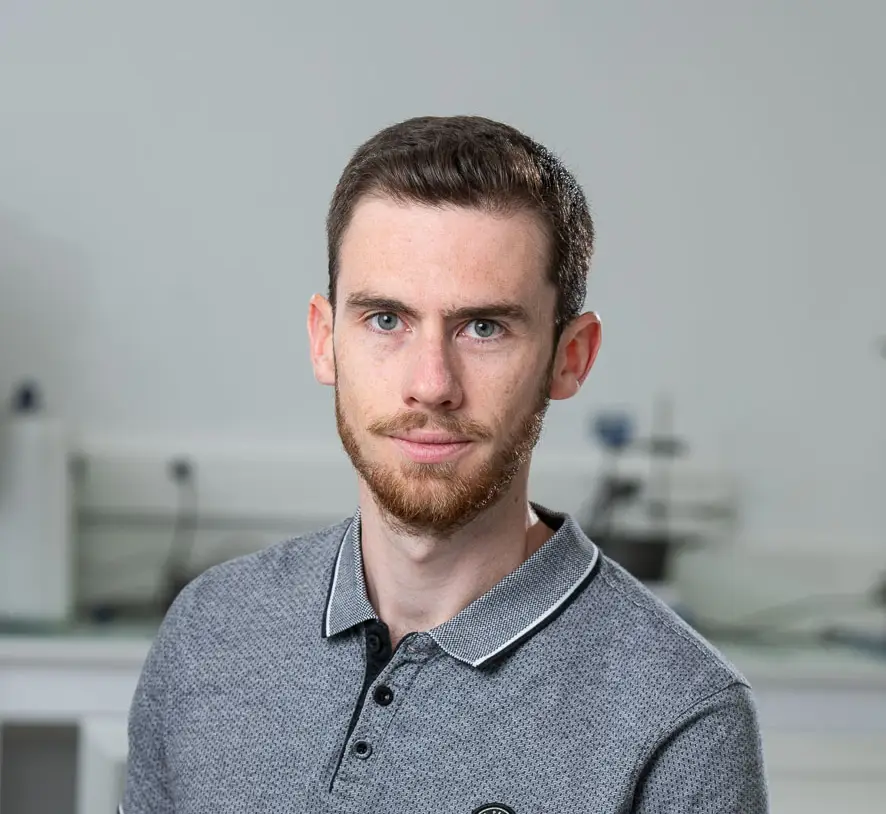
Mickael Goni
Process Rheology Expert at Rheonova
A formulation is not simply a combination of ingredients, but a complex system whose behavior directly determines the product’s performance. Instability, texture defects, phase separation, or processing difficulties often reveal poorly controlled interactions. Rheology makes it possible to link structure to actual use to anticipate these issues. It ensures a safe development process and accelerates the transition to industrial scale.
In industry, many fluids exhibit complex behavior, and simple calculations based on water no longer apply. Some manufacturers therefore choose to oversize their pumps or rely on trial and error until they get it right. With rheology, we work with our clients to anticipate how their product will behave within their process, saving them time and money.
They Trust Us


FAQ Researchers and teachers
How long does it take for a student to become proficient with easyRheo?
Generally, a 1 hour session is sufficient for a student with no prior experience to be able to run a standard protocol, acquire data, and make an initial interpretation of the results. The training is designed so that the instructor doesn’t have to spend half the lab session explaining the software.
Can easyRheo be used directly in the lab without any prior setup?
Yes. easyRheo requires no compressed air, no external thermostatic bath, and no connection to a fluid network. It plugs into a standard electrical outlet. In practice, you can bring it into any lab, set it up on a lab bench, and start a session within 10 minutes.
What types of lab sessions can be designed around easyRheo?
The most common topics in higher education are directly covered, including: flow curve analysis and rheological behavior identification (Newtonian, shear-thinning, yield-stress fluids), yield stress measurement, viscoelastic characterization (G′, G″, tan δ), real-time gelation monitoring, creep and recovery testing, and thixotropy evaluation. A catalog of ready-to-use laboratory practical (lab) protocols is available upon request.
Can students easily use the data for their reports?
Yes. The data is exported directly to Excel or CSV format, without the need for proprietary software. The curves are available immediately after the measurement. For analytical lab sessions, this allows students to work on their own data as soon as the session ends, without any extraction or conversion steps.
Does easyRheo cover the same protocols as an Anton Paar MCR or TA Instruments DCR rheometer that our students will encounter in industry?
The fundamental protocols are identical: amplitude sweep, frequency sweep, shear rate ramp, creep, step-down, and thixotropy. The measured parameters (G', G'', tan delta, yield point) are exactly the same. easyRheo therefore prepares students to work on any industrial rheometer, without the infrastructure constraints of high-end instruments.
Can easyRheo be connected to a temperature control system for lab experiments on gelation or phase transitions?
Yes. easyRheo features built-in temperature control that allows for temperature ramps or isothermal conditions. This enables particularly visual and educational lab experiments: monitoring the gelation of starch, gelatin, or epoxy resin, or studying the sol-gel transition of a hydrogel.
As a researcher, can I access the raw data to perform my own analyses?
Yes, this is a deliberate design choice. All raw data—torque, angular displacement, stress, strain, frequency—are accessible and exportable. You are not limited to the curves displayed by the software. This enables advanced analyses: harmonic decomposition for LAOS, fitting of custom rheological models, and correlation with other characterization techniques.
Do you offer support to help develop a new rheology course module?
Yes. Our engineers can visit your institution to help develop a lab module from start to finish: defining educational objectives, selecting model materials, drafting protocols, and creating answer keys and grading rubrics. We also provide remote support for teams located far away.
How do you handle maintenance and breakdowns in an academic setting, where the instrument may be used by dozens of different students?
easyRheo is designed to be robust under conditions of intensive use. In the event of a problem, our support team responds within 24 business hours. We also offer preventive and corrective maintenance contracts tailored to educational institutions, with temporary instrument replacement if necessary to avoid disrupting the lab schedule.